
Paper is Everywhere: Why the Paperless Office still hasn’t arrived
For years, the paperless office was presented as inevitable. Scanners, cloud storage, digital workflows, and e-signatures were meant to replace paper entirely. They didn’t.
Paper remains deeply embedded in everyday work. Emails are printed, contracts are scanned “just in case,” and documents constantly move between digital and physical formats. Most organisations now operate in a hybrid environment where modern systems sit alongside long-established paper habits.
This hybrid reality creates confusion rather than efficiency. Documents are duplicated, versions become unclear, and trust in information declines. Instead of simplifying work, paper and digital processes often overlap in ways that increase cost, risk, and frustration.
The persistence of paper isn’t a technology failure — it’s a process one. New tools were layered onto old ways of working without redesigning how information flows.
The goal isn’t a paperless office. It’s a less paper office — where paper isn’t the default, documents have clear ownership, and information is managed with intent.

The Paperless Office Is a Myth. Why Paper Is Still Everywhere.
The paperless office was meant to be inevitable, yet paper is still everywhere. Despite decades of new technology, most organisations operate in a hybrid world where digital systems sit on top of old paper habits. This article explores why paper persists, why scanning alone doesn’t solve the problem, and why the real challenge isn’t technology but thinking. The solution isn’t a paperless office, but a less paper office — one where documents have clear purpose, ownership, and intent.
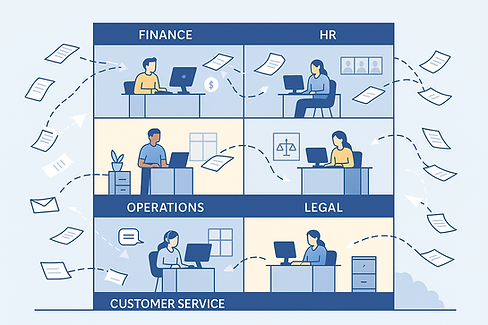
And that’s the reality most businesses live with
Despite decades of digital transformation and “paperless” initiatives, paper continues to arrive in organisations every single day.
Invoices, contracts, delivery notes, forms, letters, and records still enter the business through customers, suppliers, regulators, and internal processes. For many organisations, paper is not the exception — it’s routine.
Ignoring that reality is often where problems begin.
And this is why Paperless Fails
Why paperless fails
And why the promise rarely matches reality
The idea of a paperless office is appealing. Less clutter, lower costs, better efficiency.
But for most organisations, paperless initiatives struggle — not because people resist change, but because the starting assumptions are flawed.

Our vision
is a more realistic approach
Progress comes from acceptance, not denial.
Paper exists. The focus should be on managing it intelligently:
-
Capture paper where it adds value
-
Control documents people use every day
-
Apply governance where risk and regulation demand it
-
Improve incrementally, not dramatically
This approach lasts — because it works with reality.